

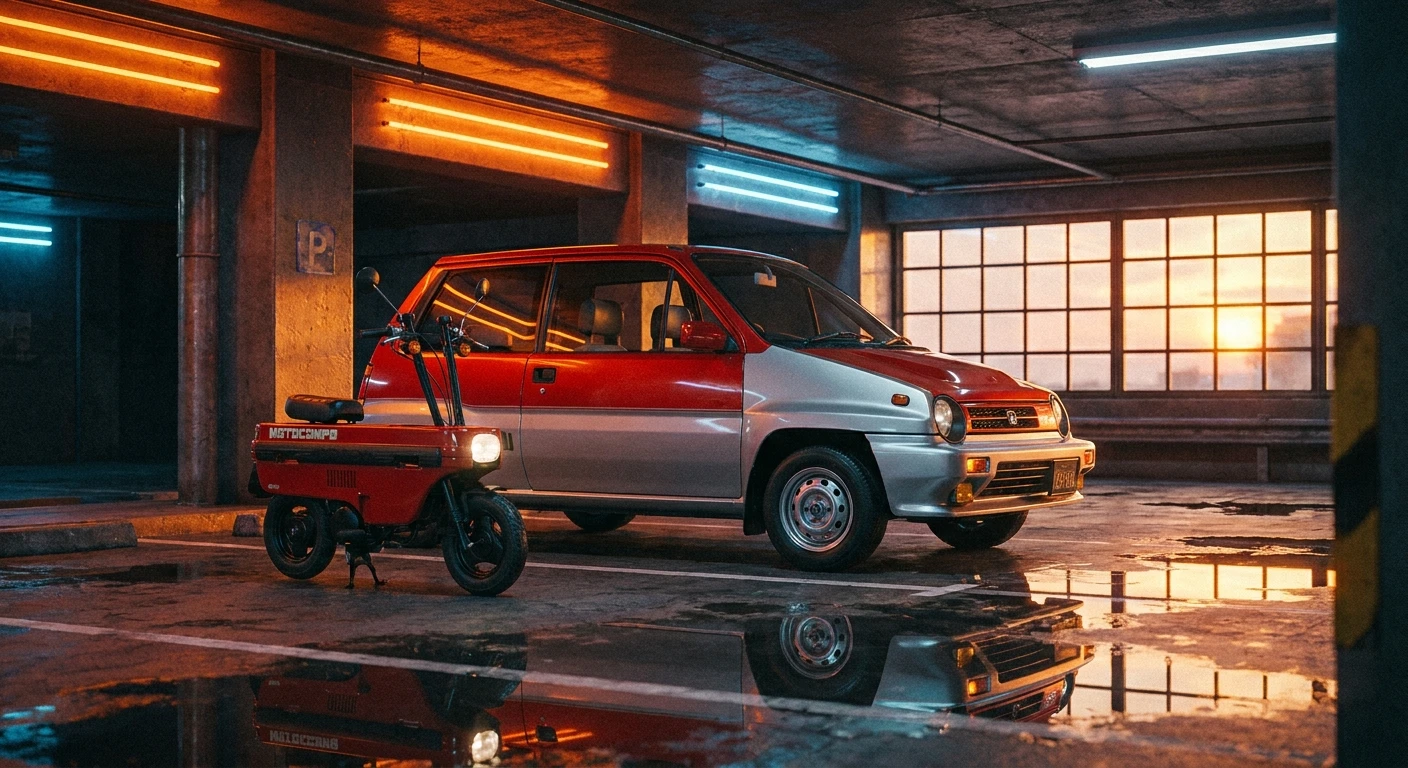
Why the Honda Motocompo Remains a Cult Classic
The quirky, box-shaped Honda Motocompo is not just a vintage miniature motorcycle; it represents an absolute masterclass in compact engineering that continues to capture the hearts of automotive enthusiasts globally. Introduced in the early 1980s as a specialized “trunk bike,” this miniature two-wheeler was specifically engineered to fit flawlessly into the rear cargo area of the subcompact City car, creating an entirely unprecedented urban mobility solution. You drive to the crowded city outskirts, park the larger vehicle, fold out the handlebars and seat of your trunk bike, and seamlessly navigate the dense traffic of the metropolis. Decades before modern electric kick-scooters dominated urban sidewalks, Japanese engineers had already perfected the ultimate last-mile commuter vehicle.
I want to break down exactly what makes this mechanical marvel function, why specialized collectors hunt them down, and how you can successfully acquire and maintain one. The brilliance of the concept lies in its spatial efficiency. Today, locating a well-preserved unit with original intact plastics is similar to finding a holy grail for JDM (Japanese Domestic Market) collectors. We will thoroughly analyze its intricate mechanics, its profound cultural impact, and the exact steps you need to take if you decide to buy one of these legendary machines for your own garage.
Read also: Aston Martin Valhalla Price: Complete Hypercar Cost Guide; KTM X Bow GT XR Price: Exploring the Supercar Cost.
Understanding the True Value and Functionality
When you evaluate the engineering proposition of this machine, you immediately see an incredibly practical solution for severe urban congestion. The primary value lies in its dual nature: it acts as a standalone, highly reliable 50cc scooter and functions as a modular accessory for a passenger vehicle. For example, the vehicle’s handlebars, seat, and footpegs fold completely flush into the rectangular plastic body shell, meaning no sharp metal edges will snag or tear your car’s interior upholstery during transport. Another prime example is the sophisticated spill-proof fuel and oil delivery system, specifically engineered so you can safely lay the scooter entirely flat on its side in the trunk without leaking hazardous, highly flammable fluids.
To truly grasp how innovative this was, look at the precise specifications that made it work as a cohesive system.
| Specification | Technical Value | Engineering Significance |
|---|---|---|
| Engine Architecture | 49cc Air-Cooled 2-Stroke | Provides adequate low-end torque for steep city inclines while keeping the overall mass extremely low. |
| Dry Weight | 42 kg (93 lbs) | Maintained at a weight threshold light enough for an average adult to manually lift and load into a car. |
| Storage Dimensions | 1185mm L x 240mm W x 540mm H | Matches the exact geometric footprint of the specialized cargo bay in the companion passenger car. |
| Top Operating Speed | Approx. 30 km/h (18 mph) | Perfectly tuned via gearing for safe, efficient navigation on crowded last-mile side streets. |
Here are the primary reasons automotive historians and dedicated vehicle collectors obsess over this tiny machine:
- Unmatched Spatial Efficiency: The completely rectangular folded footprint remains one of the most brilliant industrial design achievements of the 20th century.
- Pop Culture Dominance: Its prominent appearance in beloved media series cemented its legendary status globally across multiple generations.
- Unique Mechanical Synergy: It represents a rare historical moment where an automaker successfully designed a passenger car and a motorcycle simultaneously to act as one cohesive, integrated unit.
- Investment Viability: Due to heavy attrition rates, pristine surviving models have seen massive, steady appreciation in the vintage vehicle market.
Origins of the Trunk Bike Concept
Let us trace the story back to 1981 in Japan. The Japanese economy was booming, expanding urban centers were becoming overwhelmingly crowded, and physical parking spaces were at a massive premium. To combat this, a new subcompact hatchback was released with a very specific, highly publicized accessory. They marketed it as a “Motobike” designed expressly for the trunk. The concept was heavily promoted with vibrant, catchy television commercials featuring the UK ska band Madness. These commercials blended energetic British pop music with Japanese automotive innovation, creating a massive cultural phenomenon that instantly caught the attention of the driving public.
The Evolution of the JDM Market
Despite the incredibly strong initial marketing push, the actual production run was surprisingly short, lasting only from 1981 to 1983. Initially, the sales projections estimated around 10,000 units moving every single month. However, the economic reality was somewhat different; they sold roughly 53,369 units total during the entire three-year production cycle. The relatively high standalone price tag of the scooter, combined with the physical effort required to continuously hoist a 42-kilogram machine into a cargo bay, meant it did not achieve the absolute mainstream, long-term adoption the manufacturer originally envisioned. Consequently, production ceased, and the remaining stock was quietly sold off.
The Modern State of the Classic Mini-Scooter
Fast forward to the present day, and the narrative has completely reversed. The vehicle has transitioned from a quirky 1980s sales experiment into an ultra-desirable, blue-chip collector’s item. Because so many original units were discarded, wrecked, or neglected in damp sheds over the decades, finding a pristine, running model with flawless original fairings is extremely difficult. A massive global restoration community has emerged. Owners share detailed parts diagrams, reverse-engineer discontinued components, and utilize advanced 3D-printing technology to manufacture replacement plastic panels, keeping the mechanical dream of this folding marvel alive for future generations.
The Powertrain and Chassis Mechanics
The 2-Stroke Powertrain Mechanics
You might think a miniature scooter relies on incredibly rudimentary mechanics, but the engineering required to make this machine reliable and entirely safe to store horizontally is genuinely fascinating. The core power plant is an AB12E air-cooled, 2-stroke single-cylinder motor. Because standard 2-stroke engines require oil to be constantly mixed with fuel or mechanically injected, storing them sideways usually causes a catastrophic fluid leak. The engineers solved this monumental challenge by designing a unique carburetor and fuel tank system equipped with highly specialized manual shut-off valves. You manually turn a dedicated knob, sealing the fuel and oil lines entirely. This prevents vapor lock, stops liquid spillage, and ensures the engine will start predictably even after weeks of horizontal storage.
Foldable Chassis Engineering
The frame itself is a marvel of stress distribution and spatial packaging. To allow the handlebars to fold down flush, the steering stem utilizes a complex quick-release locking mechanism with heavy-duty forged metal clamps. Once released, the bars pivot downward into custom-molded recesses within the plastic bodywork. Similarly, the seat is mounted on a spring-loaded vertical post that retracts directly into the central frame cavity.
Here are the specific scientific and technical facts concerning its operation:
- Precise Power Output: The internal combustion engine produces exactly 2.5 horsepower at 5,000 RPM, strictly optimized for low-end torque rather than top-end speed.
- Tire and Wheel Specifications: It runs on tiny 8-inch steel wheels equipped with 2.50-8 4PR tires, balancing necessary agility with basic shock absorption.
- Suspension Geometry: It features a basic telescopic front fork and a single rear shock absorber, providing surprisingly adequate damping for a micro-scooter on uneven pavement.
- Starting Mechanism: It utilizes a primary kick-starter system, functioning entirely independently of a heavy electric battery to ensure absolute reliability and weight savings.
- Centrifugal Clutch: Power delivery is managed via a single-speed automatic centrifugal clutch, requiring no manual gear shifting from the rider.
Actionable 7-Day Buyer’s Plan
If you are seriously considering acquiring your own piece of folding history, you need a highly structured, methodical plan. The vintage JDM market can be incredibly unforgiving to unprepared, impulsive buyers. Here is a definitive seven-day action plan to locate, properly evaluate, and securely purchase your retro scooter.
Day 1: Conducting Comprehensive Market Research
Start by actively monitoring specialized Japanese automotive auction sites. Many of the absolute best-preserved models never officially leave their home country. Track the closing prices of completed auctions to establish a realistic baseline budget. Pay close attention to the visual differences between the original three factory colors.
Day 2: Sourcing a Specialized Importer
Unless you reside in Japan, you will absolutely need a trusted vehicle broker. Find a registered, highly reviewed importer who handles Roll-on/Roll-off shipping and complex customs documentation specifically for small-displacement vintage motorcycles. Verify their fee structure upfront.
Day 3: Evaluating the Plastic Fairings
The rectangular body panels are notoriously brittle and nearly impossible to find OEM (Original Equipment Manufacturer) replacements for. Scrutinize every high-resolution auction photo for hairline cracks, especially around the mounting points and the top cover latch. Damaged plastics severely reduce the overall value.
Day 4: Verifying the Fuel System Integrity
Request that the seller provides a continuous video demonstrating the fuel shut-off valve operation and a cold start. If the scooter has been stored horizontally with a faulty, degraded valve, the engine block may be entirely flooded with stale fuel, requiring a complete engine rebuild.
Day 5: Checking the Folding Mechanisms
The seat post and handlebar latches must click securely into place without excessive force. If these structural aluminum components are bent from a previous crash, the scooter becomes highly unstable and incredibly unsafe to ride. Look for deep scratches on the handlebars that indicate a drop.
Day 6: Bidding and Securing the Purchase
Set a hard, uncompromising budget, factoring in international shipping costs, port import duties, and inevitable mechanical replacement parts. Place your bid carefully through your established proxy service, ensuring you account for time zone differences during the live auction close.
Day 7: Planning the Baseline Maintenance
Once the purchase is successfully secured and the vehicle is in transit, instantly order basic consumable parts. Buy a new exact-match spark plug (NGK BP6R), high-quality 2-stroke motorcycle oil, and replacement 8-inch tires, as the original 1980s rubber will undoubtedly be heavily dry-rotted.
Myths and Reality
Over the past four decades, plenty of misinformation has spread regarding this unique, highly unusual vehicle. Let us clear up the most persistent confusion.
Myth: The scooter automatically charges its battery while stored inside the car trunk.
Reality: It operates on a completely independent, highly basic 6-volt electrical system and has absolutely no plug-in charging connection or electrical integration with the host passenger vehicle.
Myth: It is completely street-legal to ride on every major road globally.
Reality: Due to its incredibly low top speed and lack of modern safety indicators, many regional jurisdictions legally restrict it strictly to private property or secondary low-speed municipal roads.
Myth: The engine requires a complex, custom-blended synthetic racing oil to survive.
Reality: The incredibly robust, low-compression 2-stroke motor was explicitly designed for standard consumer-grade 2-stroke motorcycle oil, making routine mechanical maintenance surprisingly straightforward.
Myth: The chassis is made entirely of heavy steel to support adult riders.
Reality: While the central spine is steel, heavy use of lightweight plastics and aluminum components was necessary to keep the vehicle under its strict 42-kilogram weight limit.
Frequently Asked Questions
How much does a vintage model typically cost?
Prices vary wildly based on condition. A non-running restoration project might cost $3,000, while a pristine, museum-quality unit with flawless plastics easily exceeds $10,000 at specialized automotive auctions.
Does riding it require a specialized motorcycle license?
In many regions, a standard automobile driver’s license legally covers riding 49cc scooters. However, local licensing laws vary drastically, so always check your specific municipal regulations.
How long does it actually take to fold and unfold?
With a bit of practice and properly lubricated hinges, an average rider can fold the seat, lower the handlebars, and secure the top cover flush in well under 60 seconds.
Can you still purchase original factory spare parts?
The manufacturer officially discontinued OEM replacement parts decades ago. Current owners rely heavily on the aftermarket community, 3D printing, and custom metal fabrication to keep their vehicles running.
Was it ever officially sold in North America or Europe?
No, it was strictly a Japanese Domestic Market (JDM) exclusive during its entire production run. Every single unit currently in North America or Europe was privately imported by an enthusiast.
What paint colors were originally available from the factory?
The factory strictly offered three vibrant colors during the production run: Daisy Yellow, Shetland White, and Caribbean Red.
Is the riding position comfortable for taller riders?
The ergonomics are incredibly cramped and specifically designed for short-distance trips. Anyone over six feet tall will find the riding position highly compromised, with their knees sitting uncomfortably high.
Conclusion
The enduring legacy of the Honda Motocompo proves that brilliant, uncompromising industrial design never truly ages. It accurately predicted the future of modular, compact city commuting decades ahead of the current micro-mobility trend. If you are passionate about preserving fascinating automotive history, utilize our guide to start your search for a vintage model today and join the thriving, dedicated global community of miniature JDM enthusiasts!