
Connell Park Raceway: The Heart of Harness Racing
Welcome to the fast-paced, dirt-flying world of Connell Park Raceway, a staple of harness racing that has captivated equestrian enthusiasts for generations. Situated in the heart of Woodstock, New Brunswick, this iconic half-mile track stands as a testament to the enduring legacy of standardbred racing in the region. Whether you are a lifelong fan of the sport or a newcomer eager to understand the thundering rush of horse and sulky, the atmosphere here is unmatched. The track operates not just as a venue for high-speed competition, but as a central gathering point for a community that values agricultural heritage and equine excellence. The intricate dance between driver and horse, the tactical maneuvering required on tight turns, and the sheer power of the standardbred breed all converge on this historic dirt oval. Grasping the true significance of the raceway requires looking beyond the grandstands and understanding the deep-rooted traditions, the precision engineering of the surface, and the meticulous preparation that goes into every single race. The roar of the crowd as the starting car folds its wings is the culmination of countless hours of training, dedication, and raw athletic prowess.
Understanding the core appeal of the track requires examining the multifaceted benefits it brings to both the local economy and the broader sports community. Harness racing is a highly specialized discipline, demanding specialized infrastructure that supports both human and animal athletes. The facility provides a critical venue for breeders, trainers, and drivers to showcase their year-round hard work. Beyond the economic influx generated during race weekends, the track serves as a hub for veterinary advancements, farrier craftsmanship, and equine education.
Read also: Commonwealth Stadium Guide For Sports Fans; Top culligan water park Tips.
The value proposition of such a venue is twofold. First, it offers top-tier sporting entertainment, drawing tourists and racing aficionados who stimulate local businesses, for example, filling local hotels and restaurants during peak festival weekends. Second, it sustains the agricultural sector by creating high demand for local hay, feed, and equine care services, effectively supporting rural farming networks.
| Track Feature | Benefit to the Racing Community | Real-World Example |
|---|---|---|
| Engineered Half-Mile Layout | Promotes close-quarters tactical racing | Standardbreds must maneuver tightly, increasing driver strategy and excitement. |
| Elevated Grandstand Seating | Enhances spectator visibility and engagement | Fans can clearly track the entire field from the starting gate to the final wire. |
| Comprehensive Stabling Area | Ensures peak equine welfare and security | Provides calm, temperature-controlled environments for horses pre- and post-race. |
To truly maximize a visit to the track, fans should follow a specific protocol to engage with the sport on a deeper level. This structured approach guarantees a more rewarding experience.
- Analyzing the Daily Race Card: Before the first heat, spectators should review the past performances of the standardbreds, noting their class, preferred gait, and historical times on half-mile tracks. This data offers crucial insight into the race dynamics.
- Observing the Pre-Race Warm-Ups: Watching the horses score down the track allows observers to gauge their current form, stride fluidity, and comfort level with the dirt surface. A horse moving smoothly during warm-ups is often ready for a peak performance.
- Understanding Driver Strategy: The tactical decisions made during the first quarter-mile often dictate the outcome. Recognizing when a driver chooses to pull the right line and challenge for the lead adds immense depth to the viewing experience, turning a simple race into a high-speed chess match.
Origins of the Track
The foundational roots of harness racing in North America trace back to rural communities where driving horses were an integral part of daily life. Early competitions were informal, often taking place on country roads or flat stretches of agricultural land. The establishment of formalized racing venues provided a safer, regulated environment for these contests. Over the decades, local fairs and agricultural exhibitions recognized the immense public interest in these speed trials, leading to the construction of dedicated dirt ovals. The grounds evolved from simple cleared fields into structured venues, reflecting the growing professionalization of the sport. The local community championed the creation of a permanent fixture, ensuring that standardbred breeding and racing had a reliable home.
Evolution of Harness Racing in the Region
As the twentieth century progressed, the sport underwent significant modernization. The introduction of the mobile starting gate revolutionized the start of the race, eliminating the chaotic standing starts and ensuring a fair, even release of the field. Regional racing circuits began to formalize, creating a structured season that allowed drivers and horses to compete for standardized purses. The track surface itself transitioned from loosely packed soil to carefully graded aggregates, allowing for faster, safer racing times. The regional breeding programs flourished alongside the venue, producing robust pacers and trotters capable of competing on a national level. This era solidified the track’s reputation as a proving ground for elite equine talent.
Modern State of Equestrian Facilities
Today, the raceway stands as a modern equestrian facility while retaining its historical charm. The integration of digital timing systems, high-definition photo finishes, and advanced track maintenance equipment has elevated the standard of competition. Contemporary track superintendents utilize heavy machinery to groom the surface between every race, ensuring optimal moisture content and footing. The facility now supports a broader ecosystem of racing professionals, from specialized equine veterinarians to expert farriers who craft custom aluminum shoes. The commitment to animal welfare and fair play remains paramount, ensuring the legacy of the sport continues robustly into the future.
Track Surface Composition and Geometry
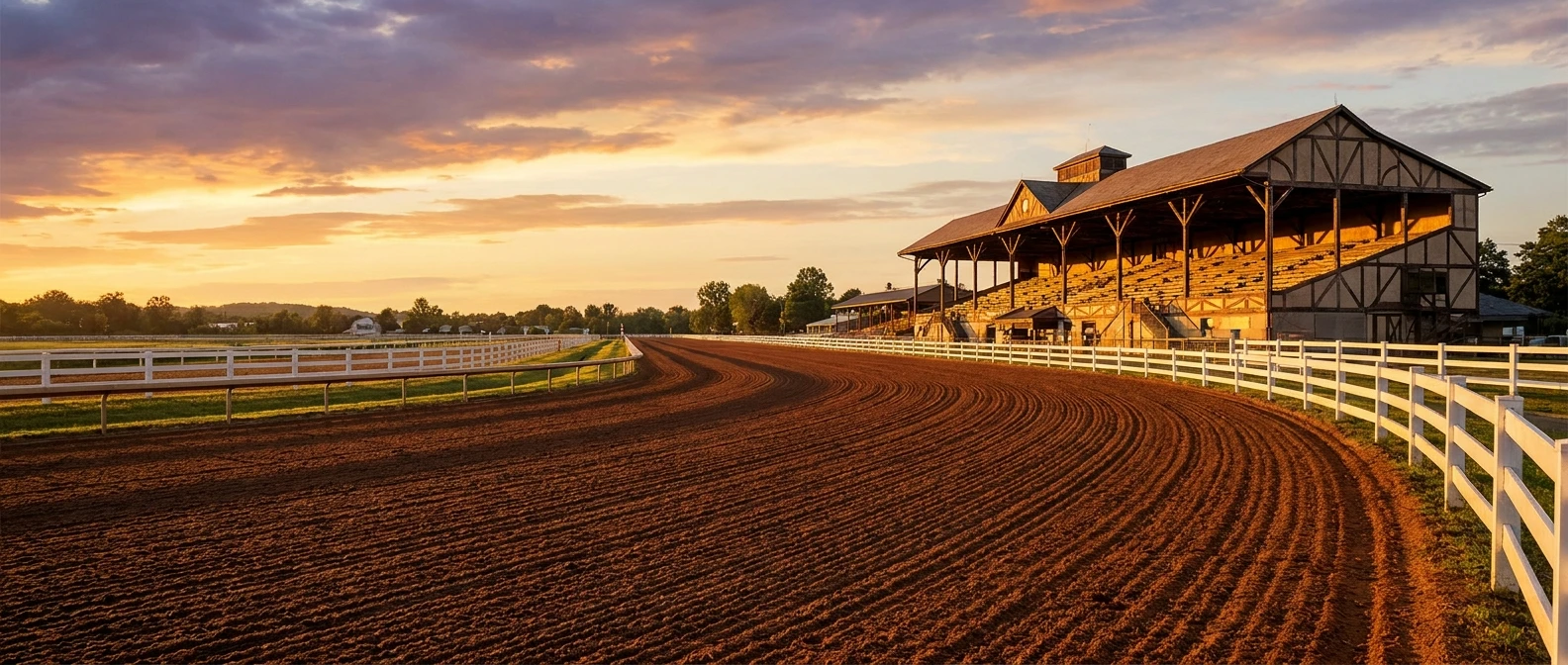
The engineering behind a half-mile racing oval is highly sophisticated. The surface is not merely dirt; it is a meticulously calculated blend of limestone dust, coarse sand, and clay. This composite structure provides a firm base that supports the immense per-square-inch pressure of a horse’s hoof while offering enough cushion to prevent lower-limb injuries. The track geometry is equally critical. The straightaways are relatively flat, but the turns feature calculated banking. This banking counteracts the centrifugal forces acting on the horse and sulky as they navigate tight corners at speeds exceeding thirty miles per hour, allowing the athletes to maintain their momentum without drifting outward toward the outer rail.
Equine Biomechanics on a Half-Mile Oval
Standardbreds compete in two distinct gaits: pacing and trotting. A pacer moves its legs on the same side of its body in unison, a lateral gait that is highly efficient and slightly faster. A trotter moves its legs in diagonal pairs, a gait that requires exceptional balance and rhythm. Negotiating a half-mile track requires specific biomechanical adaptations that are fascinating to study.
- Centrifugal Force Management: Horses naturally shorten their inside stride and lengthen their outside stride while turning to maintain balance at high speeds.
- Hoof-to-Ground Impact: The engineered aggregate surface absorbs up to forty percent of the concussive force, preserving joint health and preventing fatigue.
- Aerodynamic Draft: Drivers closely follow the competitor ahead to reduce aerodynamic drag, a tactic remarkably similar to slipstreaming in high-speed motorsport.
- Respiratory Efficiency: Standardbreds perfectly coordinate their breathing with their stride frequency, ensuring maximum oxygen uptake during the intense two-minute exertion.
Day 1: Understanding the Standardbred Breed
Begin your immersion into the sport by studying the history and physical characteristics of the standardbred. Known for their durability, calm temperament, and incredible stamina, these horses are specifically bred for harness racing. Recognize the difference in musculature and build compared to thoroughbreds, noting their powerful hindquarters and robust bone structure designed for pulling rather than carrying weight.
Day 2: Decoding the Race Program
The race program is the ultimate analytical tool for any racing fan. Spend this day learning how to read the complex lines of data. Focus on understanding speed ratings, fractional times, finishing positions, and the historical performance of both the horse and the driver over recent weeks to predict future outcomes.
Day 3: Exploring Track Geometry
Analyze the physical layout of the racing venue. Walk the perimeter of the spectator area, observing the banking of the turns and the length of the straightaways. Understand how the starting position, known as the post position, affects a horse’s tactical advantage, with inner posts generally providing a shorter, more advantageous path to victory.
Day 4: The Role of the Driver and Sulky
Focus on the vital human element of the sport. The driver does not merely sit passively in the sulky; they actively balance the cart, manage the horse’s energy reserves, and execute split-second tactical decisions. Modern sulkies are marvels of lightweight engineering, utilizing aerospace-grade carbon fiber and aerodynamic wheel discs to reduce drag.
Day 5: Veterinary Checks and Equine Welfare
Delve into the strict regulatory environment that governs the sport. Learn about the mandatory pre-race veterinary examinations, the stringent anti-doping protocols, and the standardized warm-up routines designed to ensure every horse is competing in peak physical condition while maintaining maximum safety standards.
Day 6: Attending Qualifier Races
Before a main event, tracks hold specialized qualifier races. These non-wagering events are crucial for young horses learning the ropes or veteran horses returning from a rest period. Watching qualifiers offers an unfiltered, educational look at the training process and the raw mechanics of the pacing and trotting gaits without the pressure of a grandstand crowd.
Day 7: Experiencing Main Event Race Day
Bring all your newly acquired knowledge to the grandstand for the main racing card. Listen to the track announcer call the fractions, feel the intense vibration of the horses accelerating behind the starting gate, and watch the strategic battles unfold as drivers jockey for position heading into the thrilling final stretch.
Myth: Harness racing requires no athletic skill from the driver, as the horse does all the physical work.
Reality: Drivers endure massive physical strain, constantly managing the heavy pull of the horse while aggressively leaning to balance the sulky against intense centrifugal forces around tight turns. Their tactical awareness and physical endurance are akin to elite motorsport drivers.
Myth: Track surfaces are just regular farm dirt scraped from nearby fields.
Reality: Racing surfaces are highly engineered, multi-layered pavements consisting of crushed stone bases and customized top cushions designed specifically for biomechanical safety, shock absorption, and rapid all-weather drainage.
Myth: Pacing and trotting are essentially the same exact thing.
Reality: They are fundamentally different gaits requiring entirely different sets of equipment, such as hopples for pacers, distinct shoeing techniques, and specific training regimens to maintain perfect rhythm at high speeds.
Myth: Standardbreds peak at a very young age and have short athletic careers.
Reality: Because the racing surface is softer and the sulky distributes weight efficiently instead of placing a rider on their back, standardbreds often enjoy long, healthy competitive careers, frequently racing robustly until they are fourteen years old.
Where is Connell Park Raceway located?
The track is situated in Woodstock, New Brunswick, serving as a historic hub for regional harness racing and agricultural events.
What is a half-mile track?
It is an oval racing circuit measuring exactly one-half mile in circumference, requiring horses to complete two full laps for a standard one-mile race.
Can anyone attend the races?
Absolutely, harness racing events are highly accessible, family-friendly gatherings that welcome both seasoned fans and curious newcomers.
What is the difference between a pacer and a trotter?
A pacer moves its lateral legs together in a side-to-side swaying motion, while a trotter moves its diagonal legs together in a highly balanced, high-stepping rhythm.
How fast do standardbreds run?
Elite standardbreds can easily sustain speeds of over thirty miles per hour, frequently completing a one-mile race in under two minutes.
Are the horses well cared for?
Equine welfare is the absolute highest priority in the sport, enforced by strict veterinary oversight, mandatory health checks, and comprehensive rest protocols.
What is a sulky?
A sulky is the specialized, lightweight, two-wheeled aerodynamic cart that the driver sits in, attached directly to the horse’s customized racing harness.
Harness racing at Connell Park Raceway represents a brilliant intersection of historical tradition, elite equine athleticism, and robust community spirit. By understanding the intricate mechanics of the gaits, the sophisticated engineering of the track, and the sheer dedication of the trainers and drivers, spectators can fully appreciate the thundering spectacle on the dirt oval. Step up to the grandstand, grab a race program, and experience the unparalleled thrill of this incredible equestrian sport. Plan your visit to the track today and become part of a racing legacy!